Rethinking the iPhone: Profiles for a Multi-Life World
Separating work, personal life, and side projects.
The Problem
Every part of life now sits inside one device. Work messages land beside personal conversations. Side projects fight for attention between alerts that have nothing to do with the moment.
Apps overlap. Accounts collide. Focus breaks. Context switching never stops.
This exploration started with a simple question I kept coming back to:
What if the iPhone treated each part of your life as a separate environment.
Why This Matters
From a product strategy perspective, this problem is not about aesthetics or clutter. It is about attention, identity, and the cognitive tax of switching roles every few minutes.
Smartphones try to serve every role at the same time. That creates friction in three predictable areas:
- Cognitive load
- Personal boundaries
- Security and access control
Many people work around this by carrying two phones. The workaround is the signal. It shows a gap the operating system cannot fill today.
The Concept
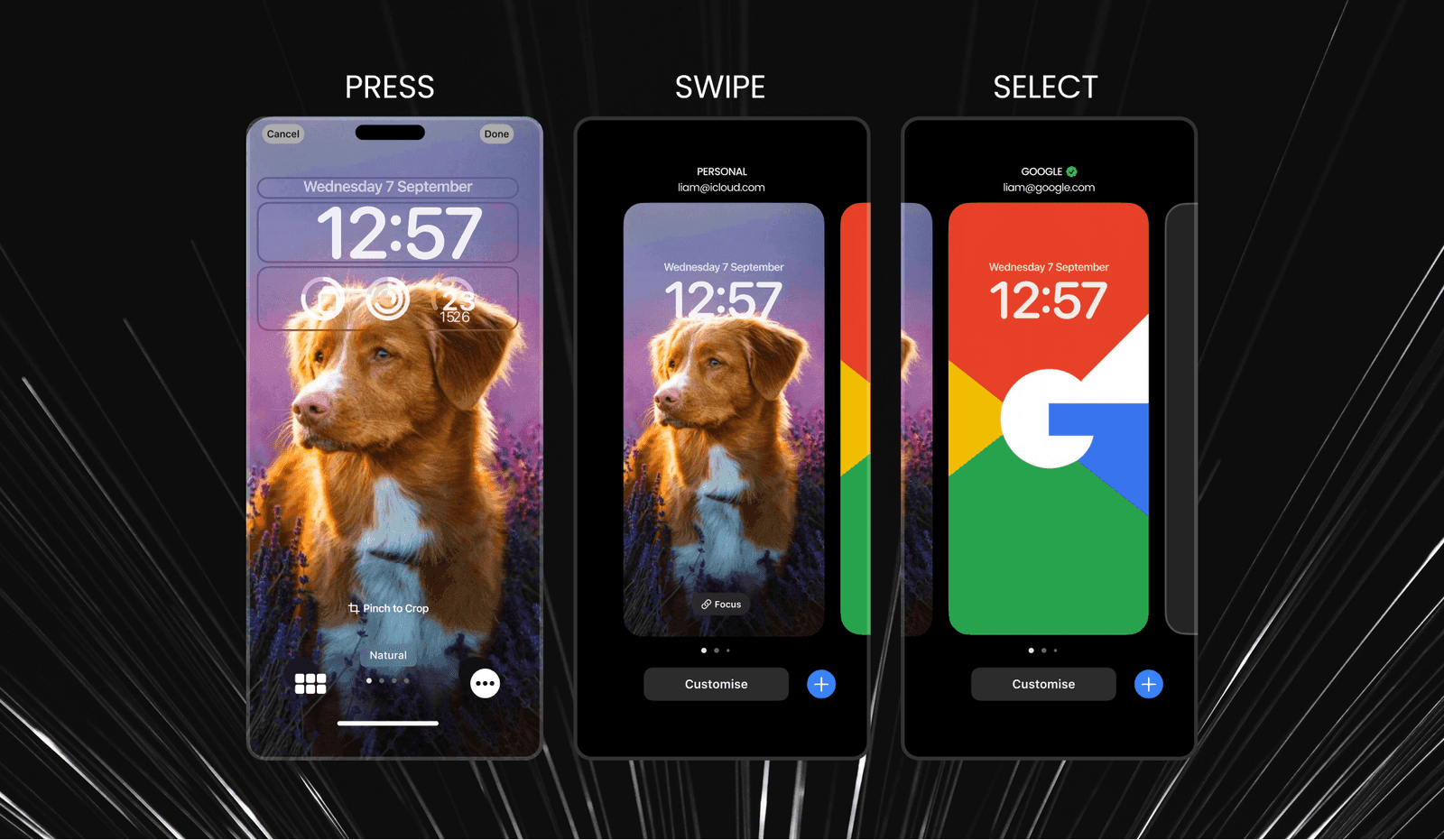
Borrow the structure of Mac user profiles and apply it to the iPhone.
Each profile becomes a dedicated environment: Work Mode, Personal Mode, Side Project Mode.
Each mode holds its own:
- Apps
- Accounts
- Notification settings
- Home screen layout
- Data boundaries
Switching profiles transforms the entire digital context. Instead of forcing all identities into one space, the phone adapts to whichever identity the user is in at that moment.
What Sparked the Idea
This idea came directly from my experience at Hard Rock International. Security policies blocked communication apps on personal devices, which forced me to carry two phones every day.
That friction made something clear. Modern life already functions across multiple contexts. The device just does not acknowledge it.
The experience raised strategic questions about:
- Productivity
- Security
- Multi-context workflows
- The limits of iOS as a single profile operating system
It also revealed how much unnecessary effort users expend to create boundaries the device should support natively.
Research and Observation
To explore whether this idea carried real weight, I looked at how people currently manage fragmented digital lives.
A few consistent patterns stood out:
- People create manual boundaries, often by carrying two phones.
- Work accounts leak into personal time and disrupt focus.
- Notification overload is a top driver of stress.
- Users want control without extra complexity.
These patterns informed the concept direction.
How a Multi-Profile System Could Work
A functional version of iOS profiles would need to balance power with simplicity. The model only works if it feels native.
Core principles:
-
Profiles must feel native Instant switching. No onboarding friction.
-
Profiles must keep data separate Work data cannot leak into personal spaces.
-
Profiles must support app-level permission sets Some apps appear in multiple profiles with different accounts.
-
Profiles must reinforce focus Each mode hides distractions that do not belong.
This is not just a UX challenge. It is a system-level question involving storage, identity, security, incentives, developer expectations, and the structure of iOS itself.
Strategic Considerations
A product strategist evaluating this concept would need to think across multiple layers:
Technical impact
How would profiles interact with iCloud, Apple ID, device encryption, and app sandboxing.
User understanding
How do you introduce profiles without overwhelming users.
Developer expectations
How would apps prepare for multiple containers or accounts.
Business incentives
How does this change Apple’s ecosystem strategy and support model.
The value is not in the feature. The value is in reducing the cognitive load that users experience every day.
Closing Perspective
This exploration is not a request for Apple to ship a new setting next year (although, it would be nice). It is a look at how digital environments shape human behavior.
If the phone is the center of modern life, the operating system should recognize that people do not operate as a single identity. They move between roles with different needs, boundaries, and expectations.
True focus begins with clear separation. A multi-profile iPhone could make that separation effortless.