Finding Clarity When Everything Is Ambiguous
A guide for early-stage teams trying to define what they are really building.
The Starting Point: Noise
Almost every early founder I speak with describes the same environment. A fog of input from advisors, investors, customers, and Slack groups. Everyone has an opinion. Most of those opinions contradict each other.
The team is moving, but not always in the right direction.
In my experience, the real bottleneck is not creativity or effort. It is clarity.
Choosing a Point of View
Teams without a point of view end up reacting to every signal. They chase markets they don’t understand and split their energy across too many possibilities.
The first real shift comes from answering one question: Who are we solving for right now.
Not the users you hope to serve in two years. Not the audience investors want to hear about. The user whose pain is sharp enough to matter today.
Once this is named, the noise drops. Ideas become sortable. The conversation shifts from “What can we build?” to “What should we build?”
The ICP Is More Than a Persona
Founders often describe their ICP in demographic terms. But real customers are defined by behavior and urgency, not age or job titles.
A strong ICP shows up through signals:
- A pain that is repeated, not theoretical
- A journey that is predictable
- A willingness to pay to solve the problem
- A behavior pattern that already exists
- An emotional driver behind adoption
When I partner with teams, I listen for the story that keeps repeating. That repetition is usually the beginning of the real ICP.
Use Cases Are the Bridge Between Vision and Reality
Vision describes the world you want to create. Use cases describe how value shows up today.
A strong use case is narrow and specific. It represents a moment where a user makes real progress: a workflow gets easier, a task becomes faster, a decision becomes clearer.
Once the right use cases emerge:
- Priorities align
- Roadmaps simplify
- Product intuition strengthens
- Teams stop debating hypotheticals
This is where strategy becomes actionable.
The Power of a Prototype
Words hide assumptions. Prototypes expose them.
A simple prototype forces alignment. It shows what users understand instantly, where friction appears, and which features no longer make sense.
It also highlights missing pieces that matter more than anyone expected.
A prototype is not a design deliverable. It is a decision-making tool.
Teams that visualize sooner learn faster, pivot faster, and avoid months of waste.
A Framework I Recommend to Early Teams
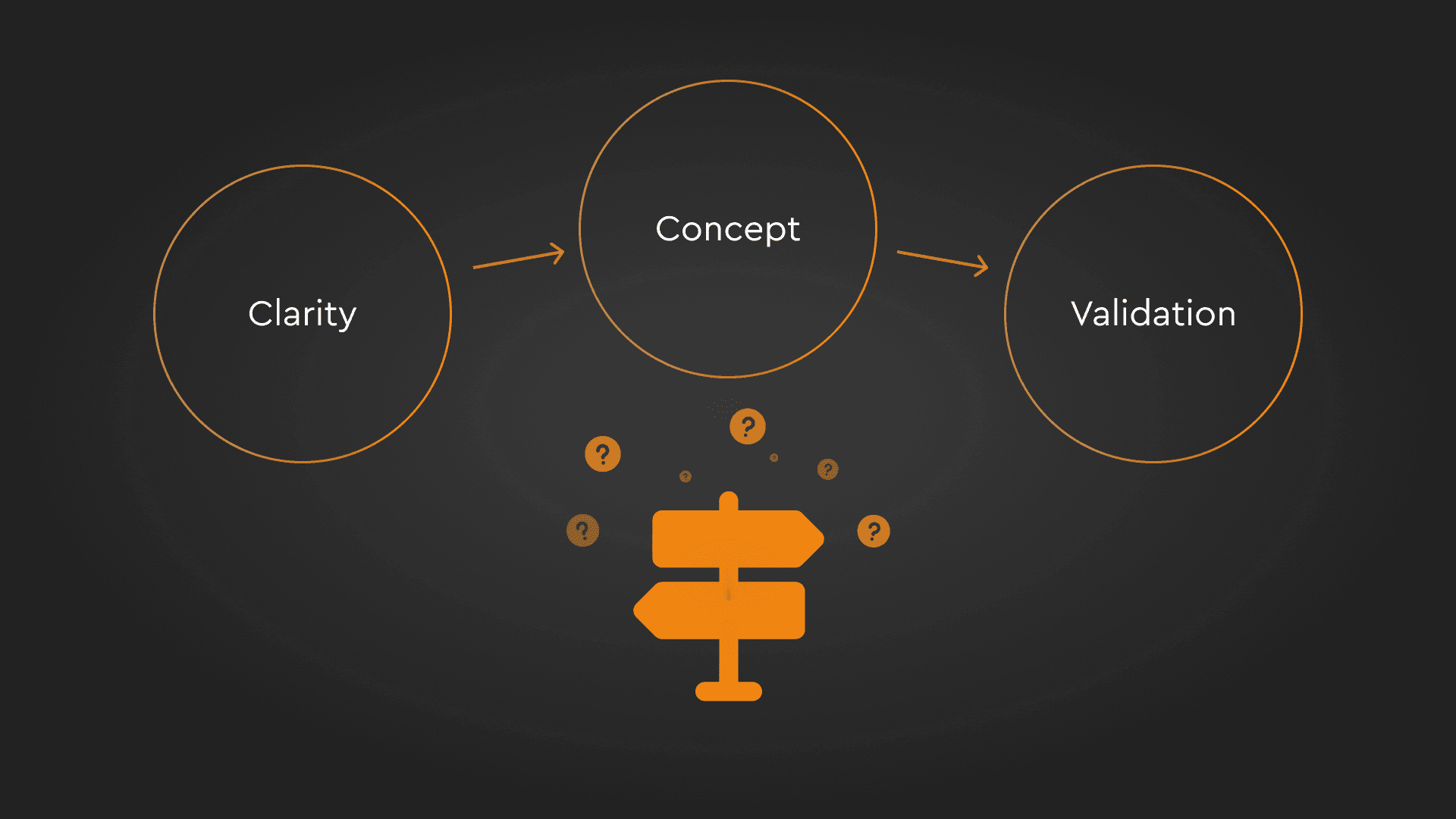
After working with founders across different industries, I keep seeing the same pattern work. When ambiguity is high, a structured process creates clarity and momentum.
Step 1: Clarity
Understand the essentials:
- ICP (who has the sharpest pain today)
- JTBD (what progress they are trying to make)
- Use Case Mapping (where value becomes real)
This step reduces noise and gives the team a direction worth pursuing.
Step 2: Concept
Translate clarity into something tangible:
- Value propositions
- Key flows
- Low and mid-fidelity prototypes
This step helps teams see what the experience could look like and exposes assumptions early.
Step 3: Validation
Test, refine, and tighten:
- User tests
- Iteration loops
- A short, believable future roadmap
This step reduces risk and helps the team commit to the right version of the product.
Clarity Is a Rhythm
Clarity is not a one-time milestone. It is a practice. The strongest founders I work with return to it anytime momentum drifts or complexity builds.
Their rhythm usually looks like this:
- Simplify the narrative
- Re-center on the ICP
- Prioritize the use case that drives the most progress
- Remove what does not serve the identity of the product
This is the discipline that turns an early idea into a product with gravity. One that users recognize, understand, and choose.